Bukhara: Central Asia's Holiest City and Its 2,500-Year Legacy
If Samarkand is Central Asia's showpiece, Bukhara is its soul. Long revered as one of the holiest cities in the Islamic world, Bukhara's historic center has remained remarkably intact for over two millennia — a genuinely lived-in museum where mosques, madrasas, and mudbrick houses still stand largely as they did centuries ago.
Ancient Roots and the Ark Fortress
Bukhara's history stretches back to at least the 6th century BCE, and its oldest surviving structure, the Ark fortress, dates to around the 5th century AD. Local folklore credits its founding to Siyavush, a legendary hero of Central Asian mythology — a fitting origin story for a citadel that would go on to house Bukhara's rulers for the next 1,500 years. Though the Ark's current form largely took shape under the Shaybanid Uzbek dynasty in the 16th century, it served continuously as a royal seat and fortified town-within-a-town until the last Emir of Bukhara fled the Bolshevik advance in 1920, ending its function as a seat of power.
A Golden Age of Scholarship
Bukhara's deepest legacy may not be architectural at all. During the Islamic Golden Age, the city became one of the great centers of Islamic scholarship and science, rivaling Baghdad in intellectual prestige. It was the birthplace of Imam Bukhari, compiler of one of the most authoritative hadith collections in Sunni Islam, and it flourished as the capital of the Samanid Empire in the 9th and 10th centuries.
From that Samanid era survives one of the true architectural treasures of the Islamic world: the Ismail Samani Mausoleum, built around 892 AD as a royal tomb. Its survival is almost accidental — when Genghis Khan's army swept through the region in the 13th century, the mausoleum had already been buried under drifting mud and sand, and it wasn't rediscovered until the 20th century, sparing it from the destruction that befell so much of the rest of the city.
Mongol Fire and a Minaret Spared
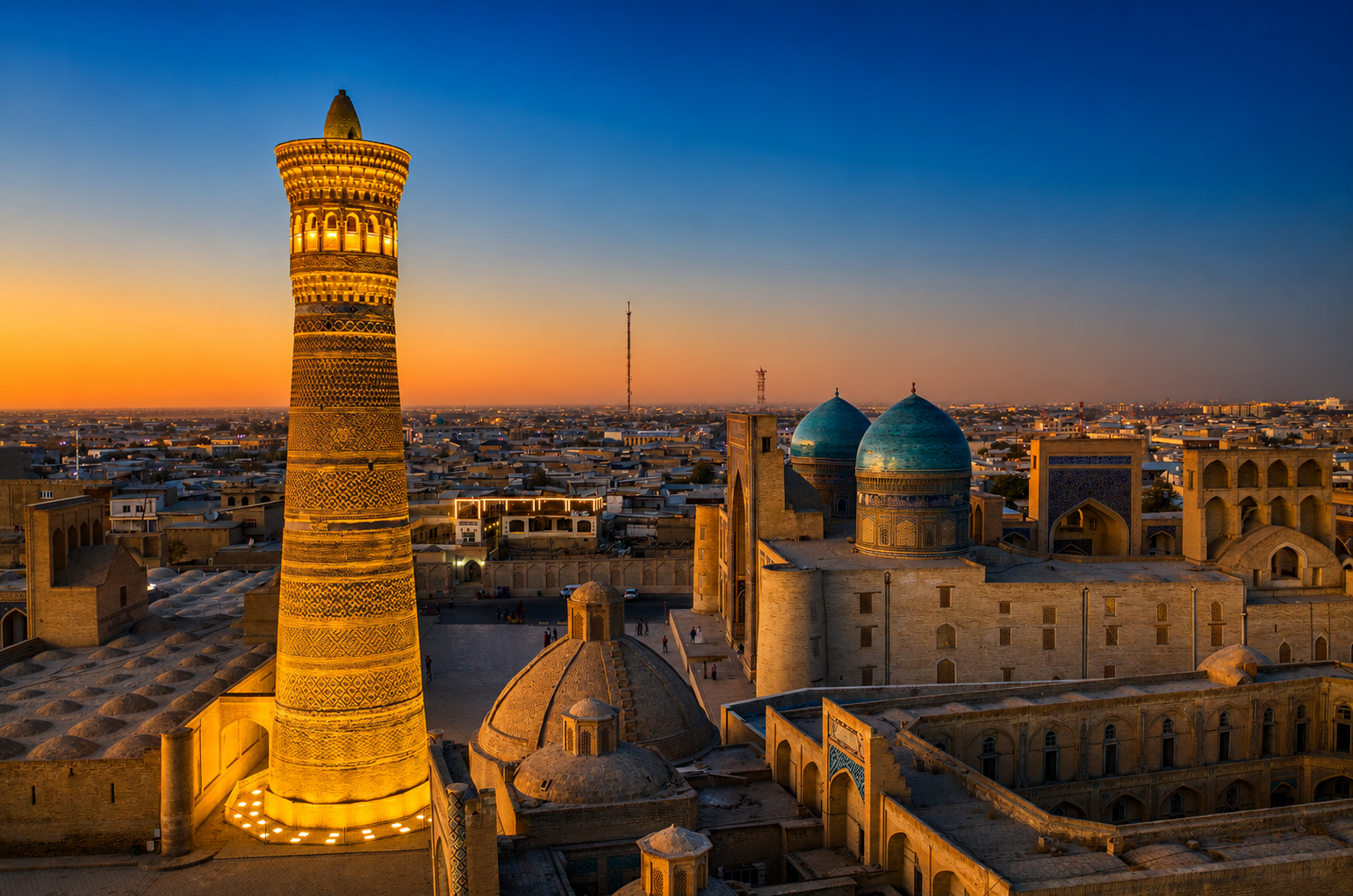
Bukhara's luck did not hold everywhere. When Genghis Khan's forces arrived in 1220, the city resisted for fifteen days before falling, and it was severely punished for that resistance. Yet one landmark survived by legend rather than accident: the Kalyan Minaret, built in 1127 by the Karakhanid ruler Arslan Khan Muhammad, is said to have so impressed Genghis Khan with its height and beauty that he ordered it spared. Standing roughly 46–48 meters tall, it was likely the tallest building in Central Asia at the time of its construction, and it served multiple roles over the centuries — as a beacon guiding caravans to the city, as a watchtower, and, more grimly, as a site of public execution that earned it the nickname "Tower of Death."
Timurid and Shaybanid Additions
The Kalyan Minaret still anchors the Po-i-Kalyan ("at the foot of the great") complex, alongside the Kalyan Mosque — rebuilt in the early 14th century and capable of holding 12,000 worshippers — and the Mir-i-Arab Madrasa, added in 1536. Timur's grandson, Ulugh Beg, left his own mark on the city in 1417 with one of his three signature madrasas (the others standing in Samarkand and Gijduvan). Later Uzbek dynasties continued building through the 16th and 17th centuries, adding structures like the Kukeldash Madrasa and the Abd al-Aziz Khan Madrasa, completed in 1652.
A City UNESCO Still Protects
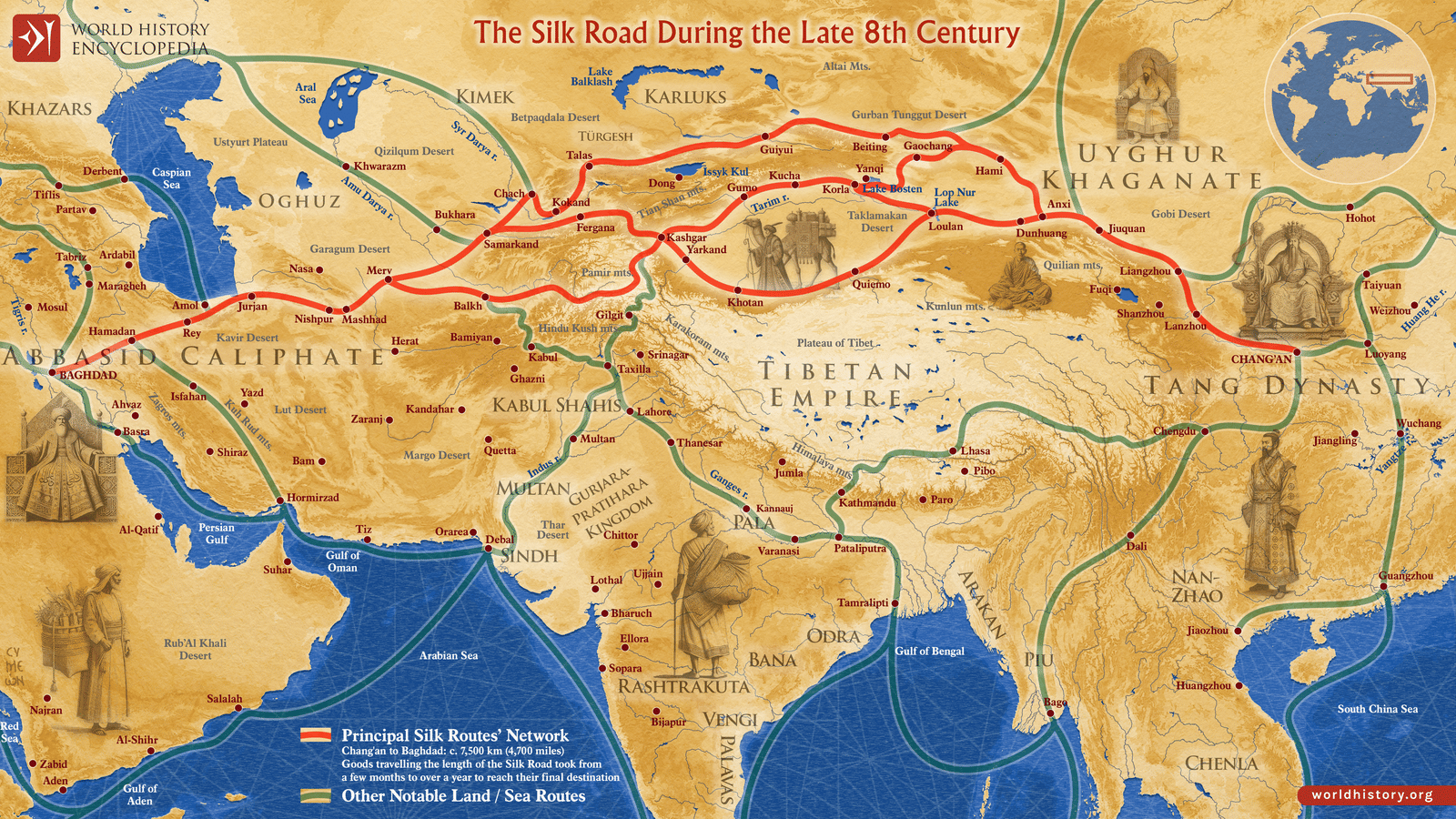
In 1993, UNESCO inscribed the historic center of Bukhara as a World Heritage Site, recognizing a townscape of mosques, madrasas, and covered bazaars that has changed remarkably little in over two thousand years. Unlike some heritage sites reduced to isolated monuments, Bukhara's old town remains genuinely inhabited — a place where daily life still moves through the same streets that once hosted Silk Road caravans, Samanid scholars, and the court of the last Emirs.